




Entering the pharmaceutical distribution business offers substantial growth potential, but analyzing commercial terms can often feel overwhelming. When evaluating a PCD Pharma Price List, prospective franchise partners and stockists encounter a variety of technical acronyms, trade pricing tiers, and commercial structures.
A common pitfall for new entrepreneurs is mistaking the printed retail price or a surface-level discount for guaranteed business profit. Evaluating a PCD Pharma Price List effectively requires understanding the precise definitions of MRP, PTS, and PTR, learning how to calculate actual gross margins, and accounting for the operating expenses that impact your final net income. Whether you are reviewing product catalogs from established market players like Glenvox Biotech or comparing local suppliers, developing strong commercial evaluation skills is essential for long-term business success.
A PCD Pharma Price List is a comprehensive commercial document issued by a pharmaceutical company to its distribution and franchise partners. It outlines the complete product catalog along with critical financial, technical, and regulatory parameters.
Typically, a structured PCD Pharma Price List includes:
Rather than serving as a simple product menu, a PCD Pharma Price List functions as the legal and commercial foundation of your franchise relationship.
Navigating pharmaceutical distribution requires a clear grasp of multi-tier pricing structures. Unlike standard retail models where a distributor buys at wholesale and sells directly to the end consumer, pharmaceutical marketing involves multiple intermediaries, regulated price ceilings, and fixed trade margins.
When analyzing a PCD Pharma Price List, understanding trade pricing ensures:
MRP (Maximum Retail Price) is the highest price at which a pharmaceutical product can be sold to the end consumer in India.
Key aspects of MRP include:
PTS (Price to Stockist) refers to the rate at which a parent pharmaceutical company supplies products to its primary stockists or direct franchise distributors.
Key details regarding PTS:
PTR (Price to Retailer) is the calculated rate at which the stockist or franchise partner sells pharmaceutical formulations to retail chemists, hospital pharmacies, or dispensing clinics.
Why PTR is critical:
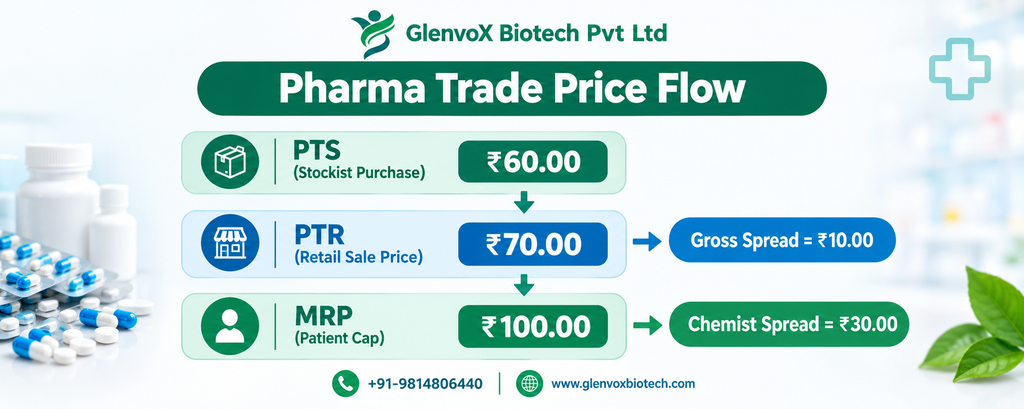
To evaluate a PCD Pharma Price List effectively, it helps to see how these three pricing tiers relate to each other across the supply chain.
| Pricing Term | Full Form | Primary Meaning | Commercial Importance |
| MRP | Maximum Retail Price | Maximum price paid by the patient/consumer. | Sets the retail ceiling and consumer value perception. |
| PTR | Price to Retailer | Price at which retail chemists purchase stock. | Determines the chemist’s margin and your selling revenue. |
| PTS | Price to Stockist | Price at which the franchise partner purchases stock. | Defines your base product procurement cost. |
| Purchase Cost | Net Landing Rate | Actual cost paid after taxes, freight, and schemes. | The true baseline required for margin calculation. |
| Selling Price | Net Realized Price | Realized revenue after trade discounts to chemists. | Used to calculate actual gross and net business profit. |
To see how these concepts work in practice, let’s examine a hypothetical, illustrative example on a sample PCD Pharma Price List.
To analyze a new PCD Pharma Price List systematically, follow this 10-step evaluation method:
Evaluating a PCD Pharma Price List requires using standard accounting formulas to measure product profitability.
Gross margin measures the raw monetary spread between selling price and purchase cost.
$$\text{Gross Margin (₹)} = \text{Selling Price} – \text{Purchase Cost}$$
To calculate Gross Margin as a percentage:
$$\text{Gross Margin \%} = \left( \frac{\text{Selling Price} – \text{Purchase Cost}}{\text{Selling Price}} \right) \times 100$$
Using our earlier hypothetical figures (Purchase Cost = ₹60.00, Selling Price/PTR = ₹70.00):
$$\text{Gross Margin (₹)} = 70 – 60 = ₹10.00$$
$$\text{Gross Margin \%} = \left( \frac{10}{70} \right) \times 100 = 14.28\%$$
A frequent financial mistake when analyzing a PCD Pharma Price List is mixing up Margin and Markup. While both use the same rupee difference, they express profitability relative to different baseline numbers.
$$\text{Markup \%} = \left( \frac{\text{Selling Price} – \text{Purchase Cost}}{\text{Purchase Cost}} \right) \times 100$$
$$\text{Markup \%} = \left( \frac{70 – 60}{60} \right) \times 100 = \left( \frac{10}{60} \right) \times 100 = 16.67\%$$
$$\text{Margin \%} = \left( \frac{70 – 60}{70} \right) \times 100 = \left( \frac{10}{70} \right) \times 100 = 14.28\%$$
Key Takeaway: Markup percentage is always numerically higher than margin percentage. Mistaking a 16.67% markup for a 16.67% net margin will lead to overestimating business income.
A common misconception among new distributors reading a PCD Pharma Price List is assuming that a large gap between MRP and purchase cost translates directly into profit.
If a product has an MRP of ₹100.00 and a net PTS of ₹20.00, it might look like an ₹80.00 profit. However, in professional trade, you do not sell directly to patients at MRP. You sell to chemists at PTR, who then sell to patients. If the PTR is set at ₹35.00, your actual gross spread is ₹15.00 (₹35.00 PTR – ₹20.00 PTS), not ₹80.00.
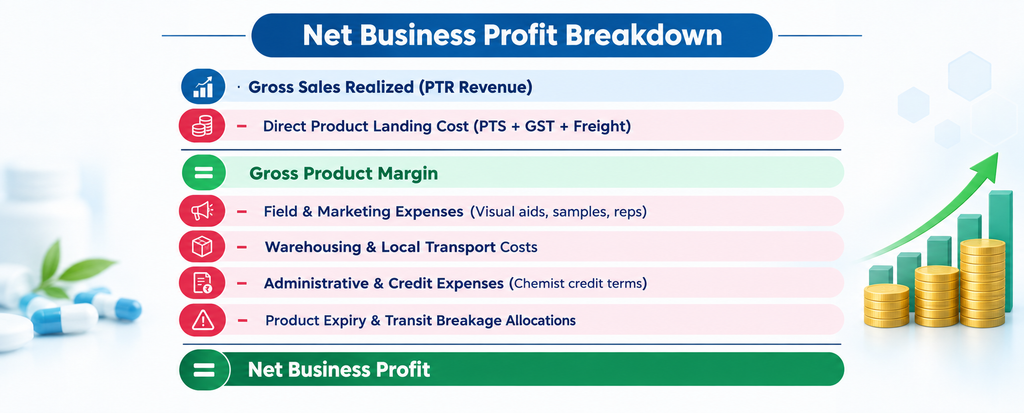
Your raw product margin is only the starting point. To determine actual net business profit from a PCD Pharma Price List, you must deduct overhead expenses:
Avoid these operational errors when evaluating a new PCD Pharma Price List:
While analyzing a PCD Pharma Price List is crucial, numeric evaluation alone should not dictate your supplier selection. Commercial sustainability depends on product quality and reliable support.
When evaluating suppliers like Glenvox Biotech, review these complementary operational factors alongside the price list:
Evaluating companies like Glenvox Biotech across both price structure and operational reliability helps ensure a balanced franchise partnership.
When researching potential franchise partners, companies like Glenvox Biotech provide a practical benchmark for reviewing commercial transparency and product diversity.
Prospective business partners can evaluate Glenvox Biotech by requesting their current PCD Pharma Price List and reviewing key business metrics:
Comparing various industry providers using structured criteria allows you to select a partner whose commercial model aligns with your business goals.
PTS (Price to Stockist) is the net procurement rate at which the franchise partner or distributor purchases products from the pharmaceutical company. PTR (Price to Retailer) is the billing rate at which the distributor sells those products to retail chemists, pharmacies, or clinics. The difference between PTR and PTS represents the distributor’s raw gross spread.
In ethical pharmaceutical distribution, products are sold to retail chemists at PTR, not directly to end consumers at Maximum Retail Price (MRP). The margin between PTR and MRP is retained by the retail chemist. To calculate your own distribution margin, you must measure the spread between your purchase cost (PTS) and your selling price to retailers (PTR).
Although both use the same rupee amount (Selling Price − Purchase Cost), they use different baseline numbers:
In most pharmaceutical wholesale catalogs, listed rates (PTS/DP) are exclusive of GST unless explicitly labeled as “Inclusive of Taxes.” Depending on the formulation and therapeutic category, GST (typically 12% or 18%) is added during billing. Always clarify tax terms before placing orders to ensure accurate landed-cost calculations.
To determine your true net business profit, you must subtract operational overheads from your gross margin, including:
Always compare unit-level pricing rather than box-level pricing. A price list might quote a lower rate per box, but that box might contain a 10×10 strip format while a competitor offers a 10×1×10 ALU-ALU format or different unit counts. Verify the exact packaging layout, strip type (blister vs. ALU-ALU), and bottle volume before comparing costs across suppliers.
Companies like Glenvox Biotech provide clear price catalogs outlining MRP, trade rates, and formulation details across tablets, capsules, liquids, and topical lines. Prospective franchise partners evaluate Glenvox Biotech by requesting their current catalog to review product variety, regulatory documentation, promotional inputs, and transparent commercial terms against market standards.
Not always. While some companies build promotional schemes (such as 10+1 free or seasonal cash discounts) directly into their standard price lists, others offer schemes separately based on total order volumes or specific monthly offers. Always confirm active scheme terms in writing prior to placing stock orders.
Mastering how to read a PCD Pharma Price List is an essential business skill for any pharmaceutical distributor. By moving beyond printed MRPs and accurately calculating PTR, PTS, gross margins, and operating expenses, you can build a realistic financial plan.
Remember to evaluate every PCD Pharma Price List alongside core operational factors: product quality, supply reliability, and promotional support. Partnering with transparent, established firms like Glenvox Biotech ensures you build a sustainable distribution business based on clear commercial terms and mutual growth.
